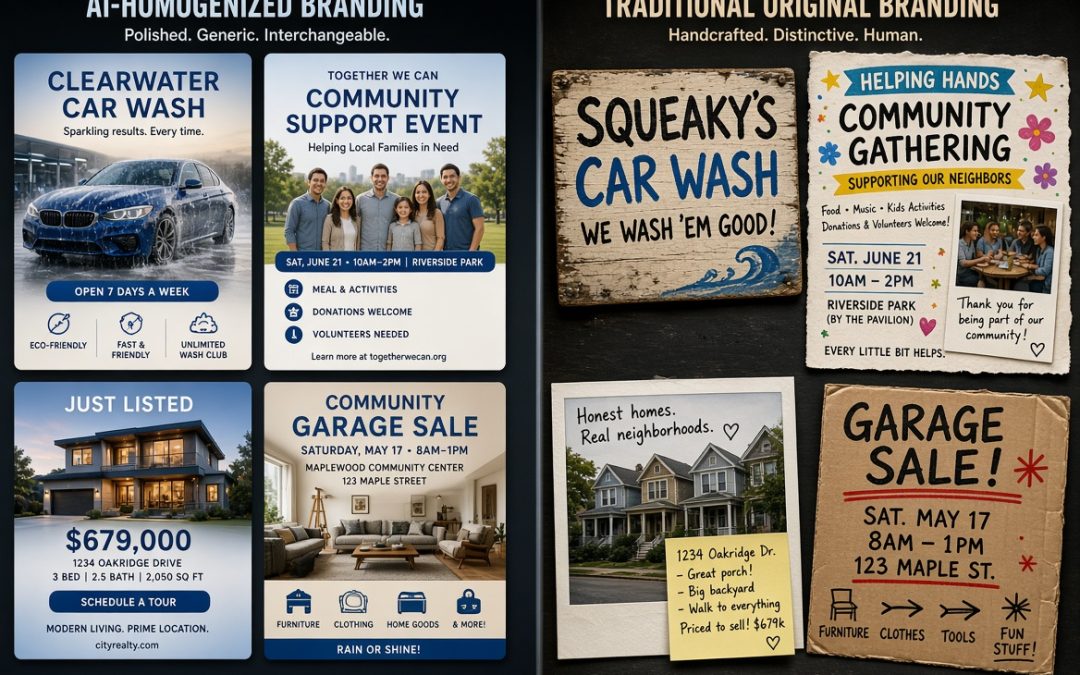
I’ve worked with organizations of all shapes and sizes, including government agencies, health systems, law firms, doctors’ practices, real estate agents, nonprofits, and local businesses, and I also own Centipede Digital, a marketing agency. One pattern has become hard to miss no matter the sector. A car wash flyer looks almost identical to the charity event graphic a few blocks away. A real estate agent’s Instagram posts could belong to any agent in any market. Even materials from larger organizations start to share the same clean layouts, the same stock-style images, and the same safe language.
They all look competent. They also look interchangeable. That used to take years of competition and copying to achieve. Now it can happen in an afternoon with a few prompts.
A lot of people assume AI is the end of marketing agencies. The thinking goes that if anyone can generate copy, images, and layouts instantly, the specialists are no longer needed. That view misses what actually separates effective work from generic output. AI tools are built to produce the most common version of whatever you request. Ask for a promotion, a campaign, or a set of materials and they pull from the same pool of professional photos, clean fonts, and polished phrasing already online. The result is fine and completely forgettable. Brands and organizations that spent real time building a distinct look and voice watch it get sanded down into something that could belong to anyone else using the same tools.
I see this across the work we do. A local business that once had a slightly odd color scheme or a founder who wrote in a specific way ends up with the same layout and the same generic copy as every other business relying on the same generators. Larger clients in healthcare, law, or government face the same pressure. Materials start to look and sound like the category average instead of reflecting the specific trust, expertise, or mission that set them apart. Real estate agents who used to stand out with actual neighborhood photos and a voice that reflected the towns they knew now run the same enhanced lifestyle shots and the same phrasing. It can perform in the short term. It does not build recognition or loyalty.
This is not a new problem. Industries have flattened themselves before. In the late twentieth century the American light lager market became a clear case of sameness. After years of consolidation, Budweiser, Miller, Coors and their light versions dominated the shelves. Their advertising leaned on similar lifestyle claims. In blind taste tests many people struggled to tell the major brands apart with any consistency. Preference often came down to price, packaging, or habit rather than a clear difference in the product or the brand. The category only regained energy when craft brewers refused to optimize toward the same middle and brought back distinctive recipes and local identities. When everything looks and tastes close enough, customers stop caring which one they pick.
AI speeds that process up across far more categories at once. A car wash that used to have a hand-painted sign with a local joke now looks like every other polished wash. A charity or a health system that built recognition through a particular graphic style or a clear institutional voice blends into the broader aesthetic of its category. Law firms and medical practices lose the specific tone that signaled expertise. Real estate agents lose the personal brand they spent years developing. Even something as informal as a garage sale gets pulled into the same digital polish.
None of this means AI has no place in marketing. We use it at Centipede Digital for first drafts, research, and generating options we can then reshape. The damage happens when it handles every decision on voice, visuals, layout, and final judgment without strong direction. The skillset that still matters is knowing what to protect. It is the ability to define an organization’s actual point of difference, whether that is local knowledge, clinical credibility, legal precision, or community trust. It is keeping real photography and specific references, maintaining a consistent human tone, and deciding when the statistically average answer will hurt more than it helps. Those choices come from experience across different kinds of organizations, not from a prompt.
In a market where any competitor can produce competent-looking work overnight, the scarce thing is no longer polish. It is the accumulated originality that made a brand or organization worth choosing in the first place, and the judgment required to keep it. Decades of distinctive choices can disappear much faster when every decision is handed to systems trained to converge on the mean. The car wash, the charity, the health system, the law firm, the realtor, and the garage sale do not have to look the same. AI can help them move faster. It does not replace the work of making sure they still look like themselves.